


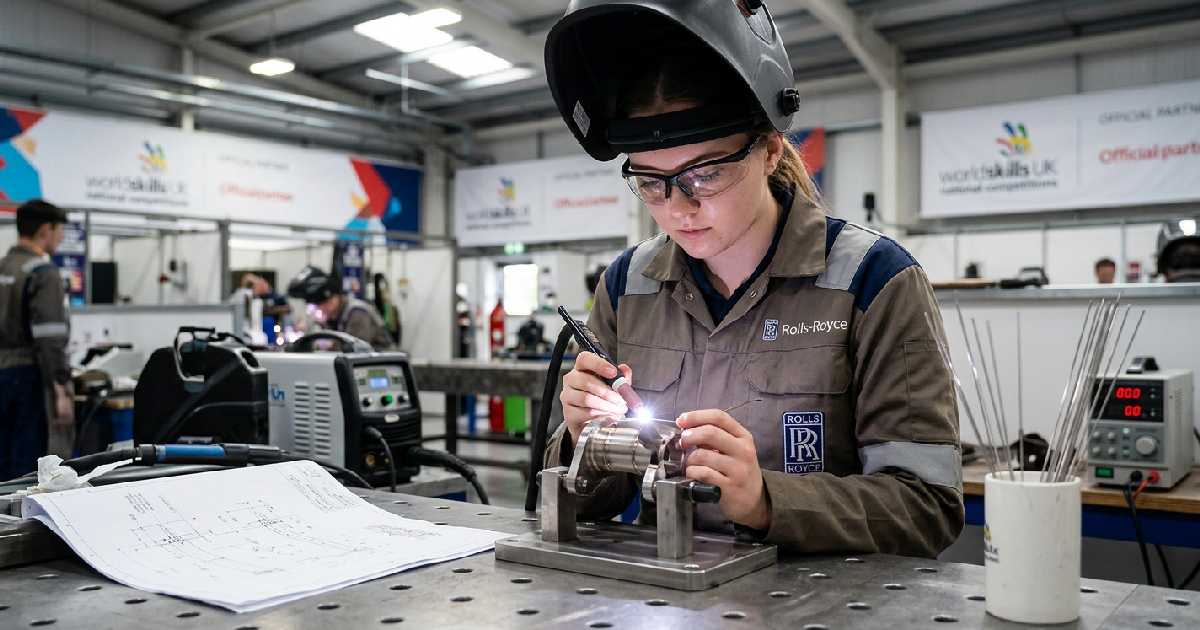
An apprentice from Rolls-Royce reportedly earned a top-tier placement in the welding category at the WorldSkills UK national finals, according to reports surrounding the technical competition. The event, which gathers the country’s most proficient young technicians, serves as a benchmark for the United Kingdom’s vocational training standards. For a manufacturer like Rolls-Royce, having a representative perform at this level highlights the rigorous training protocols maintained within its internal engineering academies.
WorldSkills UK is designed to test vocational limits by requiring participants to execute complex tasks under strict time constraints. The competition focused on high-integrity welding, a skill set that remains critical for the production of aerospace and energy components. As industrial and engineering stocks react to shifts in manufacturing capacity, the ability of firms to produce master-level craftsmen is often viewed as a key indicator of long-term operational health.
The success of high-level apprenticeships reflects a strategic focus on manual precision in an era of increasing automation. Mastery of techniques such as Tungsten Inert Gas (TIG) and Metal Inert Gas (MIG) welding is essential for components that operate in high-stress environments. This technical proficiency ensures that structural integrity is maintained in sectors where dimensional tolerances are measured to extreme degrees of accuracy.
Advanced Welding Standards in Precision Engineering
During the finals, participants were tasked with joining various materials, including aluminium and stainless steel, to exacting specifications. Judges typically evaluate these welds based on penetration levels, aesthetic consistency, and the ability to follow complex blueprints. For an apprentice to reach the podium, they must demonstrate consistent focus over several days of practical challenges, mirroring the demands of a commercial production line.
Rolls-Royce has historically invested in its apprenticeship schemes to mitigate a widening skills gap in the heavy engineering sector. By training technicians to meet international competitive standards, the company secures its proprietary manufacturing processes against a shrinking pool of specialised labor. This focus on technical excellence is mirrored globally as the African IoT sector expands through industrial connectivity, requiring a similar blend of traditional trade skills and modern digital monitoring.
The role of mentorship within these facilities is reportedly a major factor in these competitive outcomes. Senior engineers work with apprentices to transfer metallurgical knowledge and hand-eye coordination techniques that cannot be taught through textbooks alone. This transfer of tacit knowledge is the cornerstone of high-value manufacturing, ensuring that legacy skills remain within the workforce as senior staff reach retirement age.
The Impact of Skills Competitions on Industrial Growth
Competitive benchmarks like WorldSkills provide more than just individual accolades; they serve as a measure of national industrial productivity. When a major engineering firm sees its trainees excel, it signals to the global market that the regional workforce can meet the most demanding technical specifications. This reputation for quality remains a decisive factor in securing contracts for large-scale infrastructure and aerospace projects.
The integration of digital technology into traditional trades is also shifting the curriculum for modern apprentices. While manual dexterity earned the high marks in this competition, today’s welders must also interpret data from automated systems and digital sensors. This hybrid approach to engineering ensures that the human element remains effective even as factories become more interconnected.
High-level performance in national finals often leads to consideration for international competition, providing young engineers with global exposure. This progression emphasizes that vocational training is a prestigious career path with clear routes into senior technical and management roles. It also helps change public perception of the manufacturing environment, depicting it as a high-tech space defined by precision and data.
Consistency in technical standards is particularly vital as the industry looks toward future energy and transport infrastructure. Whether the task involves a power plant or an aerospace engine, the quality of individual workmanship is paramount. This mirrors broader industry efforts where infrastructure reliability depends on the underlying technical competence of the people building and maintaining these complex systems.
